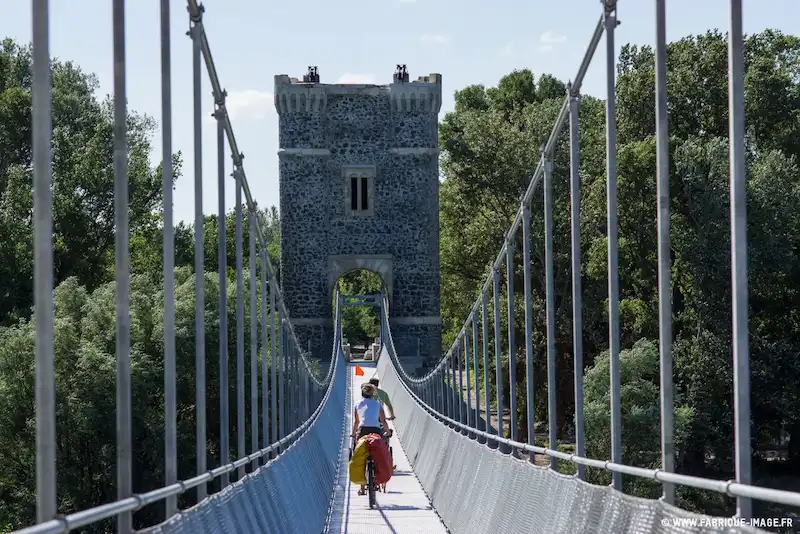
Himalayan Footbridge Florenville 184 m above the Semois
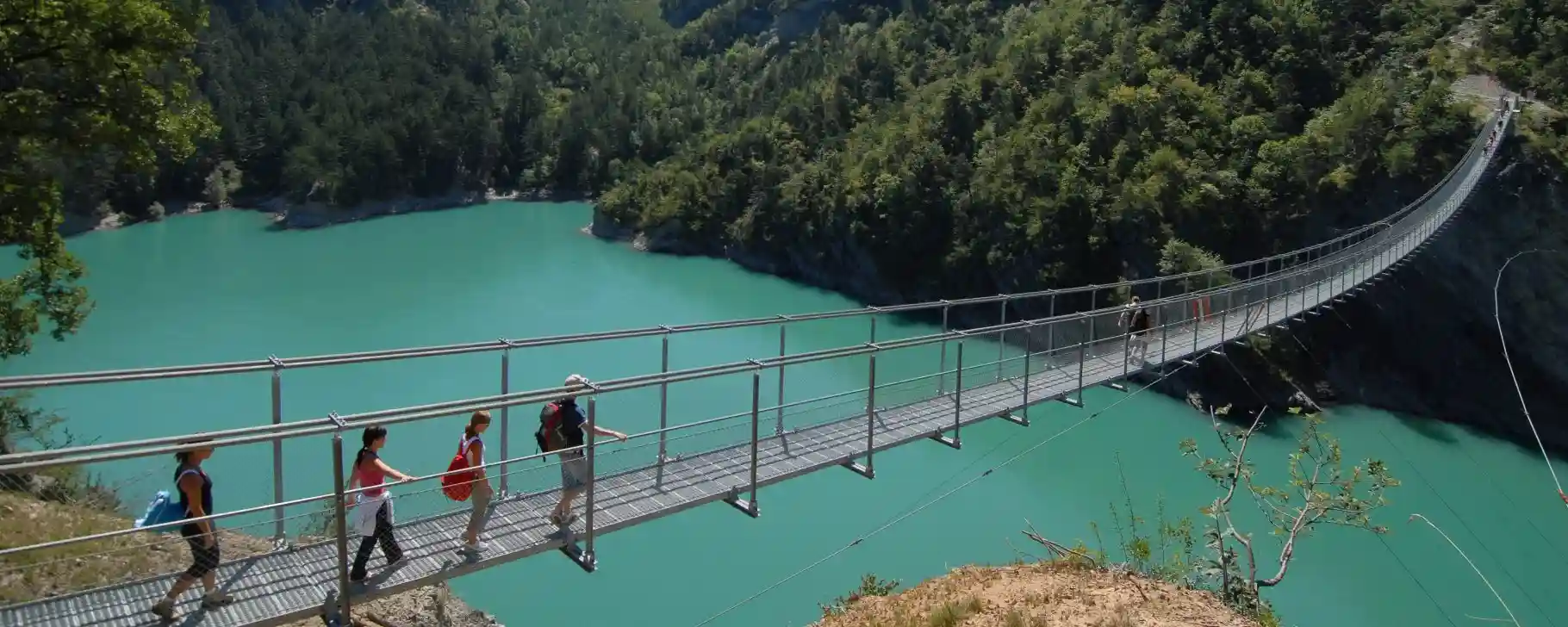
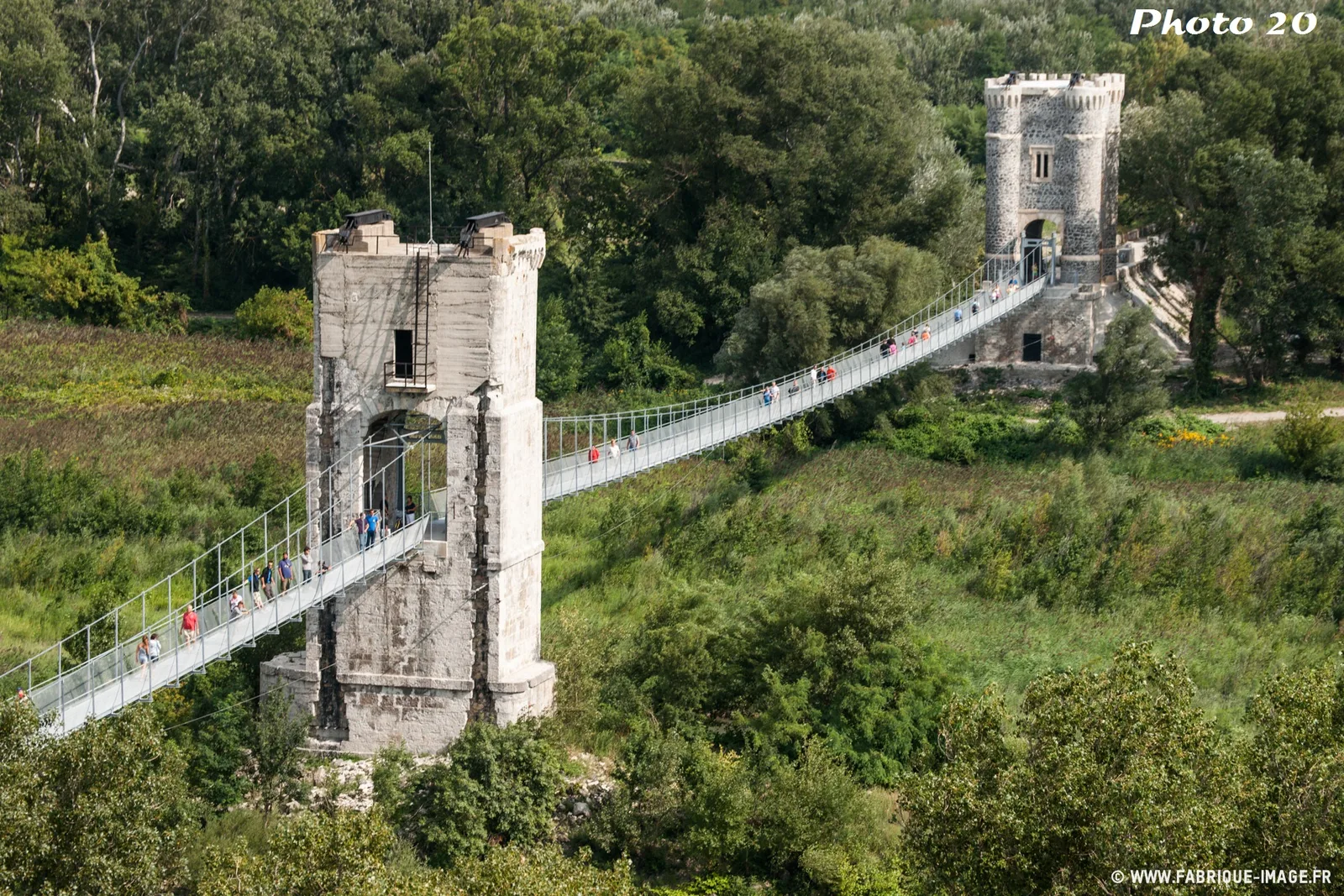
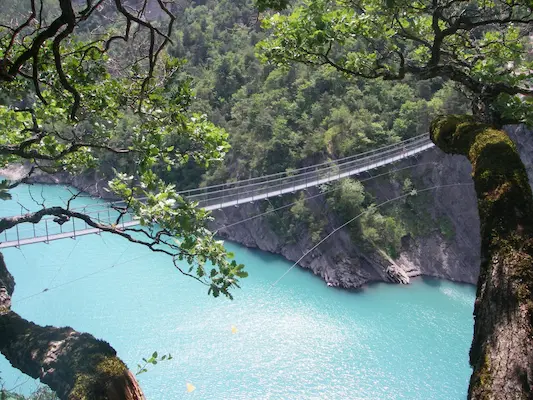
The most spectacular suspension bridge in the Belgian Ardennes connects the Sainte-Cécile forest to the Domaine des Épioux — 30 metres above the waters of the Semois.
📏 184 m long🏔️ 30 m high🥾 1.5 km walk (3 km round trip)🆓 100% Free Access 7/7🌿 Semois National Park👥 Max 540 people
2 months after inauguration : here are the essential tips based on in-depth analysis of visitor reviews and on-the-ground experience (View official Google listing and reviews ↗). Watch out for GPS traps : avoid typing « Bridge » directly into your navigation app to prevent ending up at locked National Park forestry gates. Park in Sainte-Cécile village and follow the marked forest trail (1.5 km walk).
🅿️ Recommended ParkingRue Arthur Bayonnet / Church, 6820 Sainte-Cécile (Florenville)
🧭 GPS Coordinates49.7225° N, 5.2472° E
🥾 Remaining Walk1.5 km (3 km round trip · ~45 min to 1 hour)
🌲 On-Site SignpostingMarked footpath towards the Semois & GR 16
Inaugurated on 20 June 2026, the Himalayan footbridge of Florenville (Sainte-Cécile) is the most spectacular tourist attraction ever built in the Semois valley. Visitors can now cross the river on foot 30 metres above the water along 184 metres of steel cables suspended between two forested ridges, right in the heart of the Semois Valley National Park. This page gives you all essential visitor feedback and practical tips: actual parking access, trail conditions, dog safety, dealing with heights, hiking routes, and kayak combinations.
🎧
Audio guide · ~3 min 30 · French
Himalayan Footbridge Florenville – Audio Guide
⚠️ Your browser does not support text-to-speech (Web Speech API).
Complete audio guide to the Himalayan footbridge of Florenville: 184 m above the Semois river, Domaine des Épioux, history of the iron forges, Pierre-Napoléon Bonaparte and the legend of the Roche du Chat.
The Bridge's Engineering — Technical Achievement and Logistical Challenge
Building a Himalayan footbridge in a deep gorge without road access for heavy machinery: that was the challenge faced by engineers at IDELUX Projets Publics and their partners. The solution? Héliportage (helicopter lifting) — a technique that involves transporting structural elements by heavy-lift helicopter in precision hover flight, installing them in an environment otherwise inaccessible without massive deforestation.
Detailed technical specifications
Parameter
Specification
Detail
Type
Cable suspension bridge — "Himalayan" type
Main load-bearing cables in high-strength galvanised steel
Length
184–185 metres from bank to bank
Single span with no intermediate pier in the riverbed
Clearance height
30 metres above the Semois
Calculated for a hundred-year flood event + safety margin
Human capacity
540 persons simultaneously
Dynamic and static loads integrated into structural calculations
Side safety nets fixed four times onto the load-bearing cables
Quadruple fixing certified by IDELUX engineers (Geoffrey Pélerin)
Permitted use
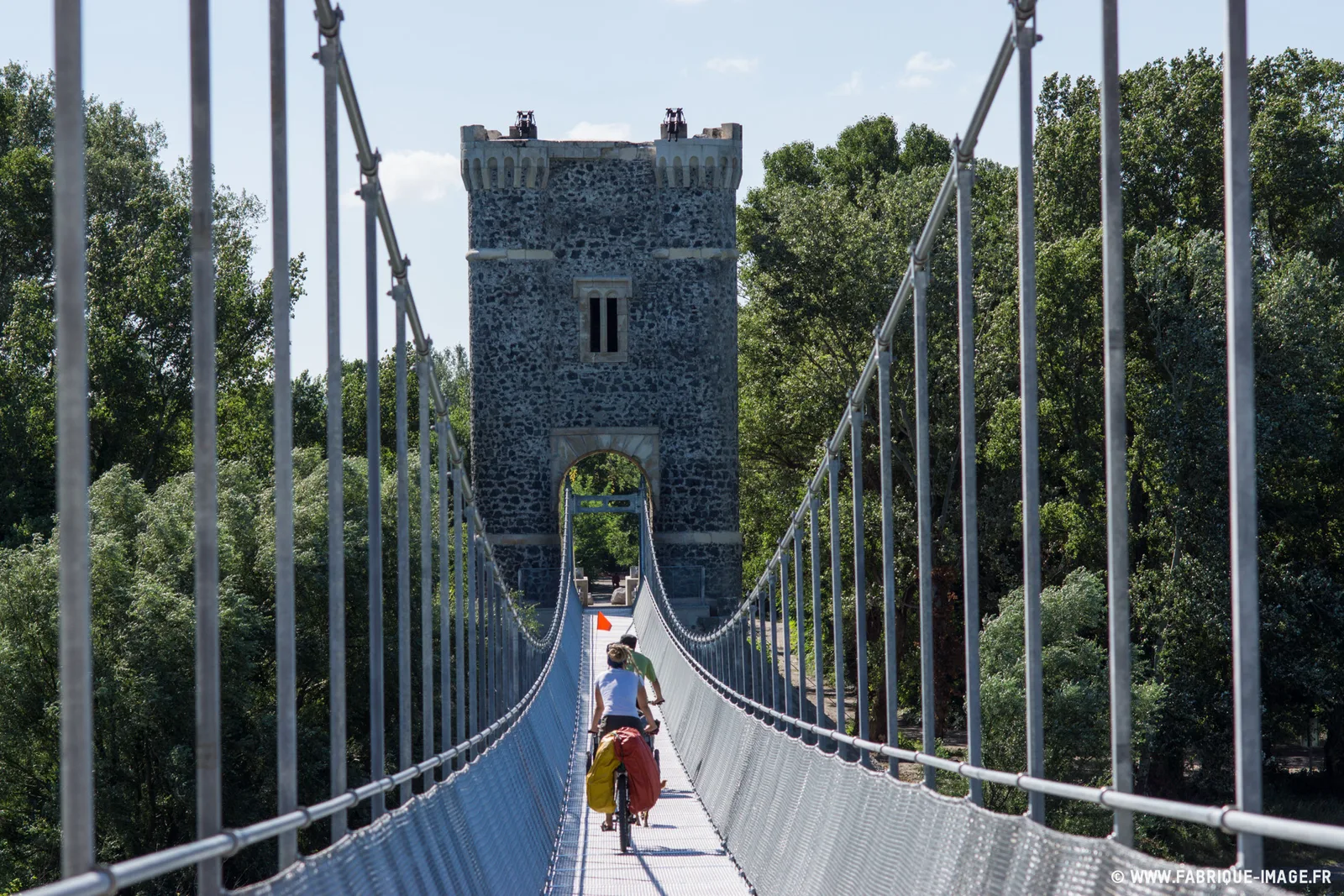
Cyclists and pedestrians — cyclists must push bikes
Pets allowed (precautions for dogs: metal grating)
Project owner
Municipality of Florenville
Project management: IDELUX Projets Publics
Why perforated metal grating?
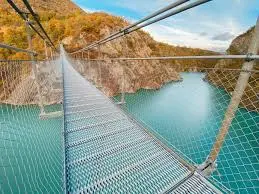
The choice of perforated metal grating for the walkway is not merely aesthetic. Technically, this material serves three critical functions:
Aerodynamics: the perforated deck dramatically reduces wind resistance, limiting the dynamic lift effect that could destabilise the bridge deck in the windy gorges of the valley.
Winter maintenance: snow, ice and dead leaves do not accumulate on the structure, reducing unexpected dead loads and maintenance interventions.
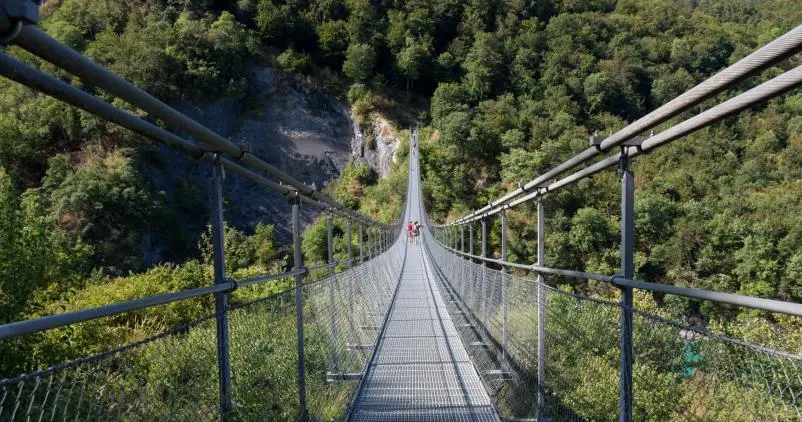
Immersive experience: walkers look directly down at the glittering Semois water 30 metres below — a vertiginous and unforgettable sensation.
⚠️ Dog owners: crossing with pets is allowed, but the perforated metal grating can injure paw pads and cause significant height-related stress (the 30-metre drop is fully visible). Please assess your dog's tolerance for metal surfaces and heights before attempting the crossing.
Helicopter construction: building without deforestation
The bridge links the Sainte-Cécile state forest to the Domaine des Épioux, both classified as Natura 2000 sites. The terrain is strictly inaccessible to conventional lifting equipment. Creating temporary access roads would have required massive deforestation and destructive earthworks in irreplaceable forest soils.
The solution of heavy helicopter lifting made it possible to assemble the bridge without altering the forest floor. Teams of rope access technicians stationed on the anchor pylons guided helicopter pilots in hover flight via continuous radio contact. The presence of high-voltage power lines (400,000 volts) in the adjacent valleys added a major operational constraint, requiring millimetre-precise coordination between pilots, preparation teams and refuellers.
Funding and Governance — A Wallonia-Backed Project
The total project cost stands at €1,400,000, covering high-performance materials, helicopter logistics, geotechnical anchorage studies in the Ardennes bedrock and precision engineering fees.
80 %
€1,120,000
Walloon Region — Tourism Commissariat Goal: post-crisis recovery, positioning Wallonia in the European ecotourism market, and valorisation of National Parks.
20 %
€280,000
Municipality of Florenville Goal: attracting tourist flows, developing the local economy (restaurants, accommodation) and residential attractiveness.
ℹ️ IDELUX's role: the intercommunal body IDELUX Projets Publics provides project management assistance (AMO). The municipality of Florenville retains full decision-making authority. IDELUX handles drafting specifications, contractor selection and financial monitoring. Project manager: Geoffrey Pélerin.
Project Timeline — From 2016 to 2026
2016
Launch of feasibility studies
The first geotechnical studies and environmental impact assessments are initiated. The site above the Semois between Sainte-Cécile and Lacuisine is identified as the optimal location.
2016–2023
Institutional coordination and permit acquisition
Negotiations with DNF (Nature and Forests Department), the CPAS of Mons (owner of the Domaine des Épioux), the Walloon Region and local residents. Integration into the Natura 2000 framework and acquisition of environmental permits.
Early 2024
Publication of the Forest Management Plan
On 5 January 2024, the FMP 2024–2048 for the Domaine des Épioux is published in the Belgian Official Gazette. This plan explicitly integrates the constraints related to the bridge and defines public channelling zones.
2024–2026
Civil engineering works and helicopter assembly
Drilling and casting of anchor blocks in the bedrock on both banks. Helicopter operations: transport and installation of main load-bearing cables, hangers and deck modules. A logistical feat in classified forest.
April 2026
Finishing phase
Deployment and quadruple fixing of safety nets. Completion of cable undersides. The construction site remains closed to the public until official authorisation is granted.
20 June 2026
Official inauguration and opening to the public
The Tourism Alderman of Florenville confirms the date. The bridge opens immediately after the inauguration ceremony, just in time for the summer tourist season.
Autumn 2026
Opening of the Maison du Garde (social tourism)
The renovation of the former caretaker's house of the Domaine des Épioux (€644,500, including €239,000 Walloon subsidy) will be complete. This social accommodation centre will welcome disadvantaged young people and school groups.
Hiking — GR 16 and GR 129 Directly Connected
The bridge radically transforms the geography of hiking trails in the southern Ardennes. By removing the last major barrier that the Semois represented in this sector, it creates a strategic hub between two of Belgium's greatest long-distance footpaths.
This mythical path follows the meanders of the Semois from its source to its confluence with the Meuse. The bridge offers GR 16 walkers direct access to the left bank and the Domaine des Épioux, opening up new loop variants that were previously impossible. The Sainte-Cécile forest is traversed on the right bank.
🔵
GR 129 — Belgium on the Diagonal
One of Belgium's longest routes, connecting Bruges to Arlon. At the level of the Domaine des Épioux, hikers can now branch off onto the GR 16 and cross the valley safely. The GR 16 × GR 129 junction forms a major crossroads for long-distance hikers crossing the country.
🟠
Cycling Route Network
The bridge is accessible to cyclists and mountain bikers, provided they dismount and push their bike for the entire crossing. This rule is essential for safety (insufficient width for passing) and to prevent any risk of falling over the guardrails.
📮
Address
Rue de la Belle Hôtesse, 6820 Florenville (Luxembourg Province), Belgium
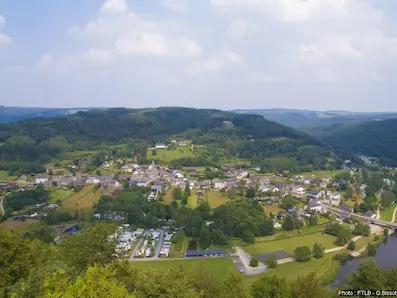
Right bank (Sainte-Cécile forest): car park at the Sainte-Cécile church (rue Arthur Bayonnet) — note: very limited capacity. Left bank (Épioux): access from Lacuisine via the road to the Vanne des Moines. The villages of Chassepierre, Muno and Herbeumont are also good bases for loop walks including the bridge.
From the Épioux bank, a marked forest path leads in 25 minutes to the Château des Épioux (built in 1650, home of Pierre-Napoléon Bonaparte from 1862 to 1871) and the Vanne des Moines. These sites make rewarding hiking destinations within the forest estate.
Accessible from the Domaine des Épioux, the Roche du Chat is a slate outcrop offering one of the finest panoramas over the Semois meanders. This viewpoint is also the setting of the famous legend of Monseigneur le Chat — a feudal tyrant devoured by giant pike, according to the oral tradition of the region.
⚠️ Parking: No large dedicated car park has been officially announced at this stage. The villages of Sainte-Cécile and Lacuisine are likely to become congested on sunny weekends. Plan a weekday visit, arrive early in the morning, or combine with the soft mobility network (cycling, shuttle).
The Domaine des Épioux — 1,707 Hectares of History and Nature
Crossing the bridge from Sainte-Cécile, visitors enter one of Belgium's most fascinating forest estates: the Domaine des Épioux, the remarkable property of the CPAS (Public Social Action Centre) of the City of Mons since 1898, managed as a PEFC-certified forest whose revenues fund social assistance in the Hainaut metropolis.
The ironworks saga (16th–19th centuries)
Long before it became an ecological sanctuary, the Épioux estate was the beating heart of the pre-industrial iron industry of the Ardennes. The ironworks of the Épioux and Roussel (Épioux-Bas) ran on a trio of local resources: iron ore from shallow mines, charcoal from the surrounding forests, and hydraulic power.
The five large ponds that dot the nature reserve today are human creations from that era — built by damming to supply water to forge hammers and blast furnace bellows. The Grand Étang alone covered 12 hectares. The Château des Épioux, built in 1650, served as the functional residence of the "forge managers", stewards of these proto-industrial complexes.
Pierre-Napoléon Bonaparte at the Épioux (1862–1871)
« Here lived from 1862 to 1871 Prince Pierre Napoléon Bonaparte, who found in the rough pleasures of the hunt and the friendship of the Ardennes people the only days of rest in his adventurous life. »
— Commemorative slate plaque, façade of the Château des Épioux
Direct nephew of Napoleon I and a man of volcanic temperament, Prince Pierre-Napoléon Bonaparte found in the deep forests of the Semois a gilded exile far from the intrigues at the court of his cousin Napoleon III. For nine years he divided his time between hunting and literature, even printing his own works on the presses installed on the estate. The town of Florenville celebrates this heritage at the Bonaparte Museum, located on the upper floor of its tourist office.
The hydrological disaster of 1888
On 21 June 1887, Victor Dejardin, a wealthy farmer from Harmignies (near Mons), purchased the estate for 630,000 francs. Local legend has it that he paid this sum in gold coins. A year later, in 1888, the Grand Étang dam broke suddenly, releasing 500,000 m³ of water. The catastrophic wave destroyed the ironworks of Épioux-Bas and caused considerable damage all the way to the gates of Bouillon.
Ruined by compensation claims and repair work, Dejardin bequeathed by testament dated 1 January 1898 the full 1,721 hectares to the civil hospices of Mons. This is how an Ardennes forest jewel came to belong to the CPAS of Mons — and remains so today.
Emblematic Wildlife — Species to Discover (and Protect)
The Domaine des Épioux and the Semois Valley National Park shelter some of Wallonia's most sensitive and emblematic species. The tourist influx generated by the bridge makes knowledge of these species essential for every visitor.
Unlike its white cousin, the black stork is a shy forest bird, extremely sensitive to human disturbance. It requires vast, ancient and quiet forests to nest in the forest canopy. The Épioux ponds are its feeding areas. Never approach nests.
🦦 European Otter
Lutra lutra
Extremely demanding regarding water quality and riverbank vegetation density. Its presence in the Semois is an indicator of the exceptional conservation status of the river network. Observe without disturbing — most active at dawn and dusk.
🦫 Eurasian Beaver
Castor fiber
Ecosystem engineer: the beaver shapes riverbanks and creates new ecological niches through its dams. Its constructions positively alter local biodiversity by creating wetland refuges for amphibians and dragonflies.
🐦 Common Kingfisher
Alcedo atthis
Its iridescent blue-orange plumage is one of the valley's most prized ornithological spectacles. It nests in the sandy or clayey banks of the Semois. Water quality and clarity are vital for its survival — its presence certifies the health of the river.
🦇 Western Barbastelle
Barbastella barbastellus
Among the 20 bat species present (out of 24 in Wallonia), the barbastelle is one of the rarest. It hibernates in the abandoned slate quarries of the region. Old-growth forests with a high density of veteran hollow trees are essential for its survival.
🐸 Great Crested Newt
Triturus cristatus
Priority species of community interest under the Habitats Directive. The ponds scattered through the Épioux meadows shelter vulnerable populations. The estate's five oligotrophic ponds — relics of the ironworks era — form its preferred habitat.
📊 By the numbers: the Semois Valley National Park shelters 110 breeding bird species (65% of Wallonia's), 69 butterfly species (77% of the regional total), 44 dragonfly species and 188 wild bee species (46% of Belgium's bee fauna). Across 22,342 hectares recognised as Sites of High Biological Interest.
The Legend of the Roche du Chat — Myth and Social Justice
A few kilometres from the bridge, accessible from the Domaine des Épioux, the Roche du Chat is a slate promontory offering one of the most spectacular panoramas over the Semois meanders. But this site is far more than a geological viewpoint: it is the setting of one of the most delightful folk legends of the Ardennes.
The Legend of Monseigneur le Chat
There was, it is said, a feudal lord of tyrannical and despotic character, unanimously nicknamed by his serfs "Monseigneur le Chat" (My Lord the Cat). This despot harboured an obsession for an aquatic nymph of the Semois — a local nature deity, as agile and elusive as the living water itself.
After many failed attempts to capture her, the lord launched an army of cats upon the river to encircle her. But the nymph, outraged, summoned a flock of herons that swooped down to harass the cats. Mad with rage, Monseigneur le Chat himself leaped into the waters of the Semois — and colossal pike surged from the depths to seize him in their razor-sharp jaws and drag him down into the icy abyss.
Moral of the tale: since that day, cats have had an irresistible aversion to water. And the Semois, it is said, still beats the base of the rock with a muffled anger on stormy nights, while ghostly meowing echoes through the forest...
Historical note: the myth is believed to have been formalised in the 18th century, during the rise of peasant dissent on the eve of the French Revolution. The punishment of the despotic lord by the forces of nature is a cathartic metaphor for social justice — a tale of resistance against feudal power.
The Maison du Garde — Social Tourism in the Heart of the Épioux
Alongside the inauguration of the bridge, the CPAS of the City of Mons is carrying out a project to renovate the estate's former caretaker's house — the "Maison du Garde" — to create a social accommodation centre with a budget of €644,500.
👨👩👧
Target audience
Young people from disadvantaged backgrounds, children in socio-economically deprived situations, people with disabilities. Access to nature and forest holidays should not be a privilege.
🌿
Green school classes
The centre will host "green class" programmes for schools — an invaluable educational tool for raising urban youth awareness about the complexity of forest ecosystems and the need to preserve Ardennes biodiversity.
💶
Funding
Total budget: €644,500. Subsidy from the Walloon General Tourism Commissariat (CGT): €239,000. Remainder funded by the CPAS of Mons: €405,500. Opening planned in autumn 2026, in synergy with the bridge inaugurated in June.
Frequently Asked Questions — Himalayan Footbridge
Is the Himalayan footbridge in Florenville open to the public?
Yes, absolutely! The bridge was officially inaugurated on 20 June 2026. It is now open freely 24 hours a day, 7 days a week, all year round.
Where do I park and how long is the walk to the bridge?
Because parking right at the bridge is restricted, visitors park at the official trail car park located about 1.5 km away (3 km round trip). Allow approximately 45 minutes to 1 hour walking along a pleasant forest path.
Is there an admission fee for the bridge?
No, access is 100% free. The footbridge is public infrastructure funded by Wallonia (80%) and the municipality of Florenville (20%). No tickets or advance bookings required.
Can I cross the footbridge with a dog?
Dogs are permitted, but great care is required: the open metal grating floor can cut paw pads or trap claws. We strongly suggest carrying small dogs or fitting protective boots on larger dogs.
Does the bridge sway significantly when crossing?
Like any authentic 184-metre suspension bridge, it gently sways and bounces with the wind and foot movements. It provides an exciting thrill while meeting the highest safety standards for up to 540 people at once.
Can cyclists cross with bicycles or mountain bikes?
Yes, but strictly on foot: cyclists and mountain bikers must dismount and push their bicycles across the entire bridge span.
Is the site accessible for wheelchairs and strollers?
The bridge deck is level, but approach trails (1.5 km) are steep and stony. The site is not wheelchair accessible and unsuitable for standard prams (a baby carrier is recommended).
Can I combine this with a kayak descent on the Semois?
Absolutely! A kayak trip down the Semois is the ideal combo: you paddle 30 metres below the bridge, then explore it from above on foot!
Check the real-time water level of the Semois before any excursion in the valley — kayak or hike. Sudden floods can submerge riverbank paths and alter access to the bridge.
Stay in Alle-sur-Semois to combine kayaking, hiking to the Himalayan bridge, and exploring the Domaine des Épioux. Camping L'Kayak Belgique, Le Laviot, Le Sagittaire, and Le Héron welcome you by the riverside.
Ready for your adventure in the Semois valley?
Combine the Himalayan footbridge with a kayak trip on the Semois — the most complete experience in the Belgian Ardennes.
« A perfect family day on the Semois. The welcome at Kayak Belgique is warm, the equipment is spotless (the kayaks are modern and clean), and the free shuttle system is superbly organised. A must-visit in the Ardennes! »
A
Annelies Peeters G
« Beautiful kayak trip on the Semois starting from Vresse! Very friendly staff and excellent shuttle service. The riverside campsites along the Semois are also a must for nature lovers. »
P
Pierre-Yves Dubuisson G
« Superb 11 km kayak descent starting from Alle-sur-Semois. The wild nature of the Ardennes is magnificent in the spring sunshine. Very competitive prices compared to the competition. We'll be back! »
S
Sandra Müller G
« Wonderful experience! The kayak tour on the Semois was perfectly organised. The team is very helpful and speaks good German. The scenery of the Belgian Ardennes is simply breathtaking. »
D
Damien Claes G
« Excellent kayak rental service and great campsite on the banks of the Semois. The prices are very fair and the atmosphere is friendly and family-oriented. The little terrace bar is perfect for a refreshing drink after the effort. »
S
Sophie Mertens G
« A fantastic last-minute welcome even though we hadn't booked in the middle of August. Life jackets and waterproof barrels are provided free of charge. Very safe descents, ideal with children! »
T
Thomas Wright G
« Top-tier kayak rental on the Semois river. Extremely friendly staff, well-maintained kayaks, and a reliable shuttle. The viewpoints along the river are absolutely stunning. Highly recommend this local business! »